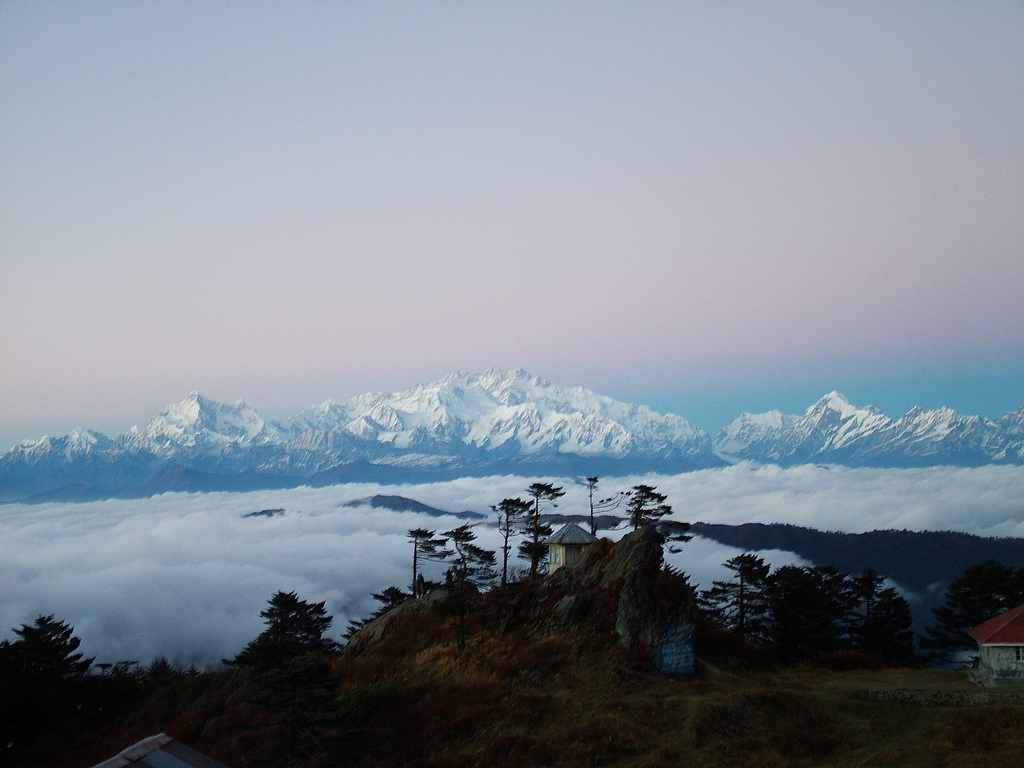
A valley that still feels unknown
Makalu, at 8,485 m, is the fifth-highest mountain on earth, a four-sided granite pyramid standing about 19 km south-east of Everest. Its first ascent was made on 15 May 1955 by the French climbers Lionel Terray and Jean Couzy, in an expedition led by Jean Franco. Below its south face lies the Barun valley, a deep glacial trench with granite walls, waterfalls and high pastures, protected since the early 1990s as part of Makalu-Barun National Park.
The park runs from the hot Arun valley at a few hundred metres to the summit of Makalu, and few protected areas anywhere span a greater range of altitude. In a single trek you walk through sal forest, rice terraces, oak and rhododendron, fir and birch, alpine meadow and moraine. Very few trekkers come here compared with Everest next door. On many nights in the Barun you may share a lodge with only one or two other groups.
The trek is demanding, and the lodges are among the simplest in Nepal. That is part of the appeal. This guide explains the route, the stages, the permits and what to expect, so you can decide whether the Barun is for you.
Getting to the trailhead
Most trekkers fly from Kathmandu to Tumlingtar, a broad river terrace above the Arun at about 410 m, in about 45 minutes. From there a jeep road climbs through Khandbari, the district headquarters of Sankhuwasabha, to Num on a ridge at about 1,560 m, a drive of four to five hours. Jeep tracks now continue in some seasons to Seduwa and beyond, which can shorten the walk in and out.
If flights are cancelled by cloud, which happens often, you can travel by road. Tumlingtar is linked to Dharan and Biratnagar by the Koshi Highway through Hile, a long day's drive, and to Kathmandu in a day and a half. Always keep a spare day or two at the end of the trip. We also like to sleep a night at Tumlingtar on the way out, because flights usually leave in the morning and the jeep road from Num can be slow after rain.
Stages and altitudes
From Num the trail drops steeply to the Arun and climbs to Seduwa, where the park permit is checked. The next day is a gentler climb through Rai and Sherpa farmland to Tashigaon at about 2,100 m, the last permanent village. Then comes the hardest stage: about 1,400 m of steep climbing through forest to Khongma Danda at about 3,500 m. We always add a rest day here.
From Khongma Danda the trail crosses open ridges to Keke La and Shipton La, at about 4,216 m, named after the British explorer Eric Shipton, then drops to Dobato in the forest. The next day descends to the Barun river and climbs to Yangle Kharka at about 3,557 m. Langmale Kharka at about 4,410 m and Makalu Base Camp at about 4,870 m follow, with a full day at base camp for a hike up the ridge toward the Barun glacier viewpoint.
| Stage | Overnight | Altitude | Walking time |
|---|---|---|---|
| Tumlingtar to Num | Num | 1,560 m | Jeep ≈ 4–5 h |
| Num to Seduwa | Seduwa | 1,500 m | ≈ 6 h |
| Seduwa to Tashigaon | Tashigaon | 2,100 m | ≈ 5 h |
| Tashigaon to Khongma Danda | Khongma Danda | 3,500 m | ≈ 6–7 h |
| Rest day | Khongma Danda | 3,500 m | Short hike |
| Over Shipton La | Dobato | 3,650 m | ≈ 6–7 h |
| Into the Barun | Yangle Kharka | 3,557 m | ≈ 6 h |
| Up the valley | Langmale Kharka | 4,410 m | ≈ 5–6 h |
| To base camp | Makalu Base Camp | 4,870 m | ≈ 4 h |
A planner can turn what you are reading into days, nights and a price.
The people along the trail
The lower villages between Num and Tashigaon are home mainly to Rai families, with Sherpa households higher up and some Gurung, Chhetri and Brahmin neighbours. People farm terraces of millet, maize and potatoes, grow large cardamom under the forest canopy and keep cattle, goats and, higher up, yak. In the trekking seasons many men work as porters and guides, and families run the lodges on the trail.
Tashigaon is the last permanent village. Above it the only settlements are kharka, summer pastures where herders bring their animals in the warm months and leave before the snow. Yangle Kharka and Langmale Kharka are both named for these pastures. Ask your guide to teach you a few words of Rai or Sherpa; a greeting in a family's own language opens doors that Nepali alone does not.
For fitness, train with long hilly walks on consecutive days and get used to steep descents, which are as tiring here as the climbs. Bring poles, broken-in boots, a four-season sleeping bag and a down jacket.
What you see from base camp
Makalu Base Camp sits on a broad flat area at the foot of the south face, which rises about 3,600 m above the huts. Chamlang, at 7,319 m, and Baruntse, at 7,129 m, are close by. On the hike up the ridge above camp, on a clear morning, the summits of Everest and Lhotse appear to the west, seen from an angle few people know.
Earlier, from Shipton La on a clear day, you can see Kanchenjunga far to the east. The Barun valley itself is the other great sight: granite walls, waterfalls, glacial streams and summer pastures where herders graze yak and dzo.
Permits and the guide rule
The standard route to Makalu Base Camp does not need a restricted area permit. You need the Makalu-Barun National Park entry permit, which has been about NPR 3,000 for foreign visitors, and it is checked at Seduwa. Since April 2023 Nepal has required foreign trekkers in national parks and conservation areas to walk with a licensed guide.
Some upper valleys in Sankhuwasabha near the Tibetan border, such as Kimathanka, are restricted areas and need a special permit. Routes that cross high passes from the Barun into the Khumbu are expeditions, not treks, and need climbing experience and different permits. Check current status before you travel.
- Makalu-Barun National Park entry permit, about NPR 3,000 per foreign visitor
- Licensed guide, required since April 2023
- Passport and Nepal visa valid for all trek dates
- Insurance covering trekking to 5,200 m and helicopter evacuation
Lodges, food and wildlife
Simple lodges now run all the way to base camp, but above Tashigaon they are basic stone huts with shared rooms, a fire, a kitchen and a short menu of dal bhat, noodles, potatoes and tea. Some close outside the main seasons, and on some departures we carry tents as a back-up. Carry enough cash for the whole trek; the last ATM is in Khandbari.
The park protects red panda, musk deer, Himalayan black bear, blue sheep and snow leopard, and many birds including the Himalayan monal and blood pheasant. Sightings of the rare mammals are uncommon, but langur monkeys, pheasants and blue sheep are often seen. Walk quietly in the forest early in the morning for the best chances.
When to go and what it costs
Late September to mid-November is the best time, with clear skies and stable weather. April and early May are also good, with rhododendrons in flower below Shipton La, though there may be snow on the pass and more afternoon cloud. From December to February deep snow can block Shipton La and most lodges close. The monsoon from June to August brings leeches, landslides and cloud.
A guided 18-night trip with flights, jeeps, permit, guide, porters, lodges and meals costs from about USD 2,450 per person. The main costs are the Tumlingtar flights, jeeps and porters, because supplies are carried in on foot.
Questions
How long does the Makalu Base Camp trek take?
Allow about 18 nights from Kathmandu, including the flight to Tumlingtar, the jeep to Num, about 14 walking days with a rest day at Khongma Danda and a full day at base camp, and the return flight. Add one or two spare days in Kathmandu for weather delays on the Tumlingtar flights.
Is the Makalu trek harder than Everest Base Camp?
In most ways, yes. The highest point is lower, at 4,870 m against about 5,364 m at Everest Base Camp, but the Makalu trail has steeper climbs and descents, the Shipton La crossing, more remote lodges and fewer rescue options. Fit walkers with some trekking experience manage it well, but it suits those who want wilderness more than comfort.
Do I need a restricted area permit for Makalu?
No. The standard route to Makalu Base Camp only needs the Makalu-Barun National Park permit and a licensed guide. Restricted area permits are only needed for some upper valleys near the Tibetan border, such as Kimathanka. Check current status before you travel.
Are there teahouses on the Makalu trek?
Yes, simple lodges run all the way to base camp, at Num, Seduwa, Tashigaon, Khongma Danda, Dobato, Yangle Kharka, Langmale and Makalu Base Camp. Above Tashigaon they are basic stone huts with shared rooms and a short menu. Some close outside the main seasons, so we sometimes carry tents.
What is Shipton La?
Shipton La is a pass at about 4,216 m on the ridge between Khongma Danda and the Barun valley, crossed together with the nearby Keke La. It is named after the British mountaineer and explorer Eric Shipton. The crossing is long and exposed, and from November to April it can hold snow, so gaiters and warm gloves are essential.
Can I see Everest from the Makalu trek?
Yes, on a clear day, from the ridge above Makalu Base Camp on the hike toward the Barun glacier viewpoint. Everest and Lhotse show to the west. From Shipton La you may also see Kanchenjunga far to the east. Mornings in October and November give the clearest views.
Who lives on the Makalu trail?
The villages above the Arun are mainly Rai, with Sherpa families higher up around Seduwa and Tashigaon, and some Gurung and Chhetri households. People farm millet, maize and potatoes, grow cardamom and keep cattle and yak. Above Tashigaon there are no permanent villages, only summer pastures used by herders.
When is the best time for the Makalu Base Camp trek?
Late September to mid-November is best, with clear skies and stable weather. April and early May are good for rhododendrons, with some snow on Shipton La. Winter brings deep snow and closed lodges, and the monsoon brings leeches and landslides. We run this trek in autumn and spring only.
How much does the Makalu Base Camp trek cost?
A guided 18-night trip costs from about USD 2,450 per person, twin sharing, including flights to Tumlingtar, jeeps, the national park permit, a licensed guide, porters, lodges and meals on trek, and hotel nights in Kathmandu and Tumlingtar. Insurance, tips and drinks are extra.