Asoj 2083 BSअसोज २०८३· Nepal runs on its own calendar

Everest & Solukhumbu · village

Khumjung

खुम्जुङ

Khumjung is one of Khumbu's largest Sherpa villages, at about 3,790 m on a wide shelf beneath the sacred peak of Khumbila, an hour and a half above Namche. It holds the school Edmund Hillary founded in 1961, a gompa keeping a famous yeti scalp, and green-roofed houses set among potato fields.

  • Stay 1 nights
  • Best Mar – Apr · Oct – Nov
  • लेकLekh
Khumjung
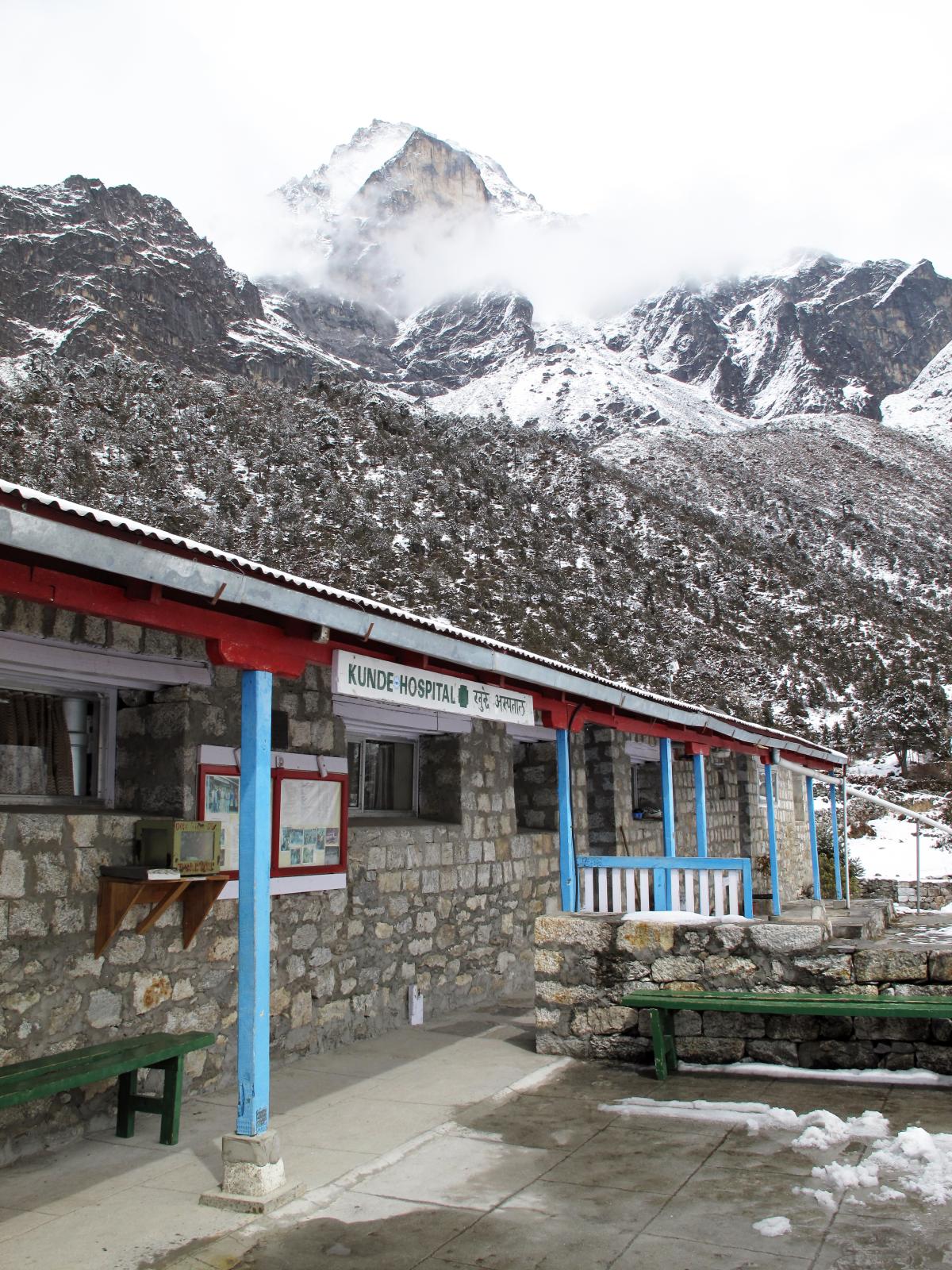
Photo: Moralist · CC BY-SA 3.0, Wikimedia Commons

The air at Khumjung

Altitude3,790 m42.8% of the way to 8,849 m
BeltLekhलेक · High hills: pasture, pine, the last fields
Each breath63%of the oxygen at sea level
Water boils87.1 °Cso dal takes longer here
vs Kathmandu-15.5 °Ctypical difference by height

Oxygen, boiling point and temperature are worked out from the standard atmosphere for 3,790 m; real days vary with weather.

Khumjung spreads across a broad, gently sloping basin, its stone houses with green tin roofs scattered among walled potato fields, with Khumbila's dark rock pyramid rising directly behind. It feels nothing like Namche: no main street of lodges, no gear shops, just a Sherpa farming village where yaks wander the lanes and children run to the school at the top of the fields.

That school is the reason Khumjung matters beyond Khumbu. In 1961 Edmund Hillary's Himalayan Trust built two classrooms here at the request of local Sherpas, the first school of many. Next door, Kunde has the hospital the Trust opened in 1966. Above the village, on the Syangboche ridge, the Japanese-built Hotel Everest View looks up the valley to Everest.

Most trekkers see Khumjung on their acclimatisation day from Namche, walking up via Syangboche and back in five or six hours. We think it deserves a night. Evenings in Khumjung are quiet and starry, mornings bring yak bells and smoke from kitchen fires, and the walk on to Tengboche via the high trail is one of the loveliest in Khumbu.

Why go

Hillary's Khumjung School

Founded in 1961 by the Himalayan Trust with two classrooms, the school now teaches over 350 Sherpa children. You can see the grounds and the memorial to Hillary from the gate; visits inside are by arrangement, and term-time mornings are for lessons, not tourists.

The yeti scalp in the gompa

Khumjung's gompa keeps a conical cap of reddish hide revered as a yeti scalp. In 1960 scientists examined it and judged it serow skin, but it remains a sacred object. The caretaker shows it in a glass case for a small donation.

Khumbila, the forbidden summit

The dark 5,761 m peak behind the village is the home of Khumbu Yul Lha, protector deity of the region. It has never been climbed out of respect. Walk the lanes at sunset when its rock face turns orange above the fields.

Tea at Hotel Everest View

Half an hour above Khumjung, the Japanese-built Hotel Everest View has a terrace facing Everest, Lhotse and Ama Dablam. On a clear morning it is the classic Khumbu panorama, and a pot of tea there is part of the acclimatisation ritual.

Kunde and its hospital

Kunde, Khumjung's twin village ten minutes west, has the hospital the Himalayan Trust founded in 1966, a small gompa and quiet lanes of stone houses. It is a gentle walk on an acclimatisation day.

High trail to Tengboche

From Khumjung a quieter path drops to rejoin the main Everest trail at Kyangjuma and Sanasa, saving the backtrack to Namche. The views of Ama Dablam on this traverse are among the best in Khumbu.

१The story of Khumjung

The village that asked Hillary for a school

Khumjung and its twin village Kunde are old Sherpa settlements, built where the shelf below Khumbila gave space for fields and pasture. Families here farmed potatoes and barley, herded yaks and nak to summer pastures, and traded with Tibet over the Nangpa La. Many of the Sherpas who carried loads for early Everest expeditions came from Khumjung, Kunde and Thame.

In 1960 and 1961 Edmund Hillary spent months in Khumbu with a scientific expedition. Village elders told him what they wanted most was a school for their children. In 1961 the Himalayan Trust, which he had just set up, built Khumjung School: two classrooms, with materials carried in on porters' backs. It grew into a full primary and secondary school with over 350 pupils. Hospitals at Kunde and Phaplu, more schools, bridges and water systems followed.

The same expedition gave Khumjung its odd fame. Hillary borrowed the gompa's revered yeti scalp, a conical cap of reddish hide, and took it abroad with a village elder, Khunjo Chumbi, for scientists to examine. They judged it to be made from the skin of a serow, a Himalayan goat-antelope. The scalp came home and still sits in the gompa, where visitors may see it for a donation.

२The legend
As it is told · खुम्जुङ

Sherpas say Khumbila, the 5,761 m peak above Khumjung, is the home of Khumbu Yul Lha, the god of the Khumbu country, protector of the region and its people. In gompa murals he appears as a white-faced figure in white robes riding a white horse. Because the mountain is his home, local tradition holds that no one should stand on its summit, and it has never been climbed. Families offer juniper smoke and prayer flags to him before journeys.

३The people

Who lives here

Khumjung and Kunde are Sherpa villages, among the largest in Khumbu, with roughly 1,900 people recorded in Khumjung's ward in 2011. Families farm potatoes, barley and buckwheat, keep yaks and nak, and run a few lodges, but many earn their living as climbing and trekking guides. Sherpa is the home language; children learn Nepali and English at the Hillary school. Several renowned Everest climbers grew up here.

४Words you will hear
Sherpa
དགོན་པ
gompa

Monastery or village temple

Sherpa
ཁ་བཏགས
khata

White silk or cotton scarf offered as a blessing or welcome

Sherpa
nak
nak

Female yak; the 'yak' cheese and butter come from her milk

Every word on this site

५What to eat

Boiled potatoes with chilli salt

In Khumjung homes the simplest meal is the best: Khumbu potatoes boiled in their skins, peeled at the table and dipped in ground chilli and salt, often with somar cheese. Ask your lodge for a plate; the local potatoes are small, dense and good.

६Few people know

Things most guides leave out

Khumjung School was built by Edmund Hillary's Himalayan Trust in 1961 and began with two classrooms. It now teaches pre-school, primary and secondary pupils, over 350 of them.

Wikipedia: Khumjung

The yeti scalp kept in Khumjung's gompa was taken abroad in 1960 by Hillary's expedition for examination. Scientists concluded it had been moulded from the hide of a serow, a goat-antelope.

Wikipedia: Yeti

Kunde Hospital, a short walk from Khumjung, was founded in 1966 by Hillary's Himalayan Trust and still serves Khumbu villagers, porters and trekkers.

Wikipedia: Kunde Hospital

Untold Nepal, region by region

Getting there

How to reach Khumjung

On foot

From Namche, about 1.5–2 hours via Syangboche, climbing some 350–450 m, or a little longer via the lower path past Kunde. From Khumjung, Tengboche is about 4–5 hours via Kyangjuma and Phunki Tenga.

Air

Helicopters can land at Syangboche, 30 minutes above the village, but flying directly to about 3,800 m without acclimatisation is dangerous. Fixed-wing flights go to Lukla, three walking days away.

Where to stay

Khumjung has a small number of family-run lodges with simple rooms, shared bathrooms and warm dining rooms where you eat with the owners. They are quieter than Namche and give a real sense of village life. Kunde has a few more. For comfort, Hotel Everest View, about 30 minutes above the village at roughly 3,880 m, has rooms facing Everest, but book it only after acclimatising in Namche or on the way down.

Local tips

  • Spend a night here on the way down if you missed it on the way up; the village is calm and the evenings are clear.
  • Carry small notes for the gompa donation box and the yeti scalp viewing.
  • Do not walk into the school grounds uninvited during lessons; ask your guide to arrange a visit.
  • Walk around chortens and mani walls clockwise, keeping them on your right.
  • Sleep in Namche first before sleeping at Khumjung or Hotel Everest View, which are 350–450 m higher.

On the map

Khumjung and what is near it

Map of Khumjung, Namche Bazaar, Tengboche, ThameIndiaChinaNepalKoshiKhumjung1KhumjungNamche Bazaar2Namche BazaarTengboche3TengbocheThame4Thame50 kmN
  1. 1Khumjung
  2. 2Namche Bazaar
  3. 3Tengboche
  4. 4Thame
Drawn by Book Nepal Trip from Natural Earth outlines (public domain). International borders as depicted by Nepal. Rivers: Karnali, Gandaki and Koshi systems. Not for navigation.

Questions

Khumjung: what travellers ask

How high is Khumjung?

Khumjung lies at about 3,790 m, some 350 m above Namche Bazaar. For most people it is a step up in altitude, so we recommend two nights in Namche before sleeping here. As a day walk from Namche, climbing to Khumjung and returning to sleep lower is ideal acclimatisation.

Is Khumjung worth visiting?

Yes. It is one of the largest Sherpa villages in Khumbu and feels very different from Namche: farm lanes, yaks, stone houses and few lodges. It holds Hillary's first school of 1961, the gompa with its famous yeti scalp and views of sacred Khumbila. Kunde's hospital and Hotel Everest View are within 30 minutes.

How do I get from Namche to Khumjung?

Walk up the steep path above Namche to the Syangboche airstrip, then over the ridge past Hotel Everest View and down into Khumjung, about 1.5–2 hours. A lower path via Kunde is a bit gentler. Many trekkers loop back to Namche the same day; others continue the next morning towards Tengboche.

Why has nobody climbed Khumbila?

Khumbila is sacred to Sherpas as the home of Khumbu Yul Lha, the protector deity of the region. Out of respect, its summit is not climbed, and Nepal does not issue permits for it. It is a reminder that in Khumbu mountains are not only scenery but homes of gods, which is why prayer flags and juniper offerings mark many ridges.

Can I stay overnight in Khumjung?

Yes. Khumjung and Kunde have a few family-run lodges with simple rooms and shared bathrooms. They are quieter and more personal than Namche's lodges. For more comfort, Hotel Everest View is 30 minutes above the village. Sleep here only after acclimatising in Namche, or on the way down from higher up.

What is the yeti scalp in Khumjung?

It is a conical cap of reddish hide kept in Khumjung's gompa and revered as a yeti relic. In 1960 Hillary's expedition took it abroad with a village elder for study; scientists judged it to be moulded from serow skin. It came back and is still shown for a donation. Treat it as a sacred object.

Is Khumjung on the Everest Base Camp route?

Not directly. The main trail from Namche to Tengboche contours below it, but Khumjung is a short detour, and many itineraries pass through on the acclimatisation day or walk the high trail from Khumjung to rejoin the main path at Kyangjuma. It adds little time and much interest.

What is the best time to visit Khumjung?

October and November offer the clearest skies and mild days. March to May is also good, with rhododendrons in flower lower down. December to February is cold, with nights well below freezing, but clear and quiet. June to September is monsoon, often cloudy, with fewer lodges open and unreliable flights to Lukla.

Who are the people of Khumjung?

Khumjung is a Sherpa village, home to families who have farmed, herded yaks and traded here for generations. Many residents work as climbing and trekking guides, and several noted Everest climbers grew up in Khumjung and Kunde. Sherpa is the first language; Nepali and English are learned at school.

Plan with a local planner

Tell us your height, we will find the trail

Easy hills or a 5,000 m pass, a week or a month: three short questions and a planner sends a first plan, with the sleeping height of every night and an itemised price.

  1. १Tell us where, when and how high you want to go
  2. २Get a first plan and an itemised price within one working day
  3. ३Change anything until it fits. Pay a deposit only when you book
Plan my Nepal trip